Made-to-measure wooden walk-in wardrobes in Nerja
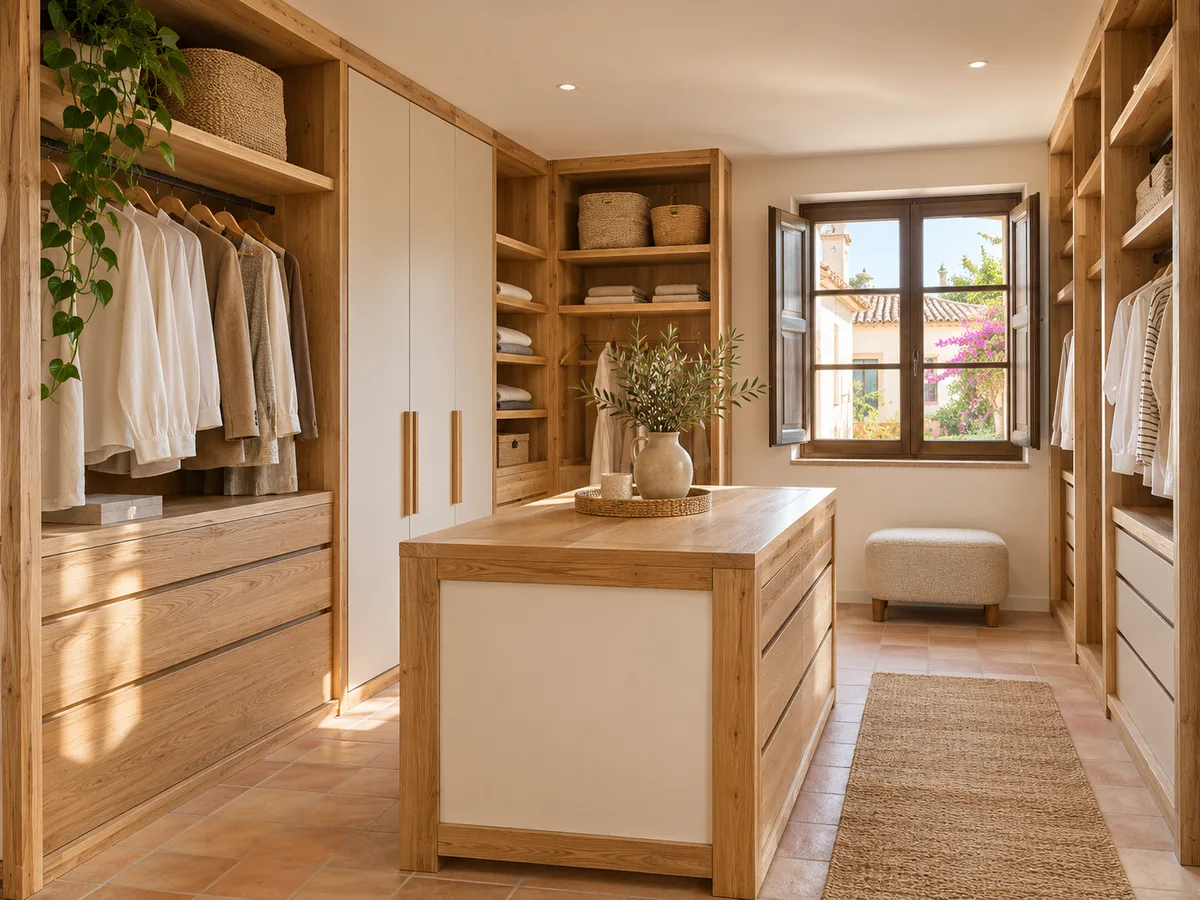
When you talk about a wooden walk-in wardrobe, it's worth being clear about which wood you mean: it could be solid wood, natural veneer on a board, or a decorative finish with a printed grain, and each one behaves differently. This page will help you decide on the material for your made-to-measure wooden walk-in wardrobes in Nerja, without getting into styles just yet. You'll see which parts of the unit deserve a quality timber and which can be done with something simpler.
Shape your next wardrobe.
Try out the measurements, plan the interior layout and choose your finishes. See your idea take shape and share it with us so we can prepare your quote.
Send us your configuration with your measurements and we'll give you a guide price within 24 hours, free of charge. The measuring visit at your home comes afterwards.
Deciding where you want visible wood
A walk-in wardrobe has a lot of surface area, and using quality timber everywhere rarely pays off. The practical approach is to start with what gets looked at: the drawer fronts, the sides you can see from the door, the upper shelves and the bench, if there is one. What sits behind the clothes or inside a drawer can be done in an engineered board in a matching tone.
Sketch or describe which walls you see when you open the door of the room in Nerja. That first glance shows where the grain will carry the most weight and helps guide how the budget is split between materials.
Solid wood, natural veneer and decorative board
Solid wood is wood all the way through. It has real grain on the edge too, and it can be sanded and refinished, but it is heavier, moves with changes in humidity and makes the unit more expensive. Natural veneer is a thin sheet of genuine wood bonded to a stable board: it allows large, even side panels with the look of natural wood. Decorative board has a printed pattern or a melamine paper that imitates the grain, stands up well to wear and costs less.
All three are perfectly legitimate, but each should be called by its proper name in the proposal. That way you know whether what you're looking at is real wood or a well-executed imitation.
Materials for the carcass, fronts and accessories
A walk-in wardrobe is made up of parts with different demands. The structure carries weight and must be stable, so it's usually made from good-thickness engineered board. The drawer fronts and doors, if there are any, are the most visible parts and can be veneer or solid wood. Accessories such as rails, trouser racks or shoe racks can be metal with a warm finish or in the same wood.
Mixing materials is normal and sensible. A long solid wood shelf without reinforcement can bow over time, whereas a veneered shelf on a rigid board keeps a straight line for years. We check each piece with that logic before finalising the design.
Have you already measured the space?
Send us a photo and the approximate measurements on WhatsApp and we'll give you some initial guidance.
Tone, grain and physical sample
- 01
The colour of wood changes with the light, the floor and the walls around it. A light oak can look almost grey against a cool white wall and golden next to a warm one. That's why the final decision shouldn't be made from a photo, but from a large sample held against the wall of your walk-in wardrobe.
- 02
The direction of the grain matters too. Vertical grain makes the unit look taller, horizontal makes it look wider, and a strong grain draws the eye while a soft one blends into the whole. We ask you to look at the sample at different times of day before deciding on the tone and finish.
Combining wood with other surfaces
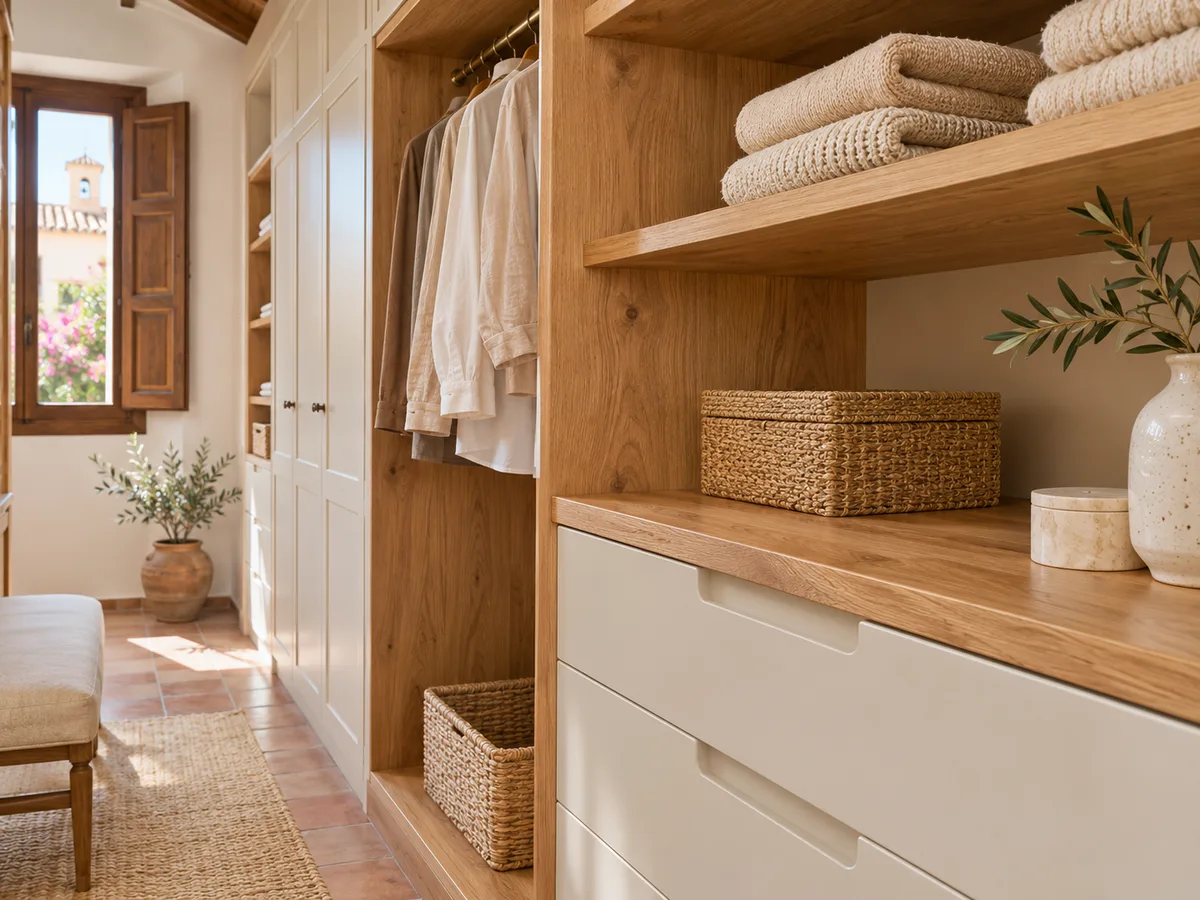
It's rarely a good idea for the whole walk-in wardrobe to be made of the same material. Wood looks its best alongside smooth surfaces: a painted back panel, a white shelf, a lacquered front, black metal or brass on rails and handles. The contrast makes the grain stand out and avoids a cave-like effect.
A useful rule is to stick to one main wood and, at most, one supporting finish. If your floor is already wood, choose a different tone for the walk-in wardrobe, slightly lighter or darker, so the two don't blur together. We'll sketch a couple of combinations so you can compare which one suits your home.
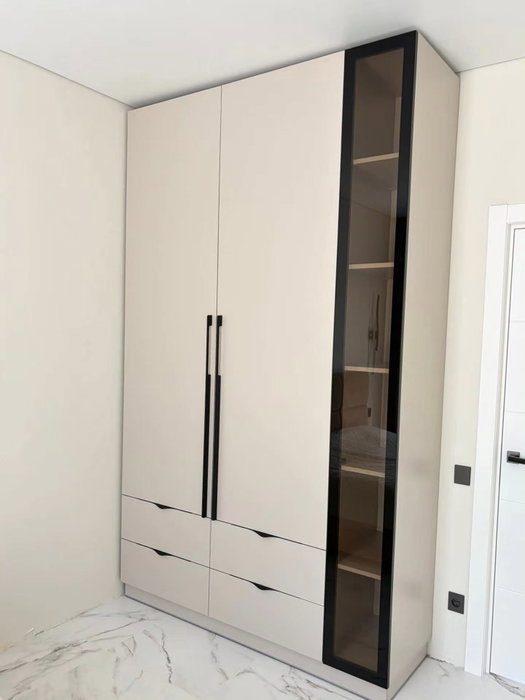
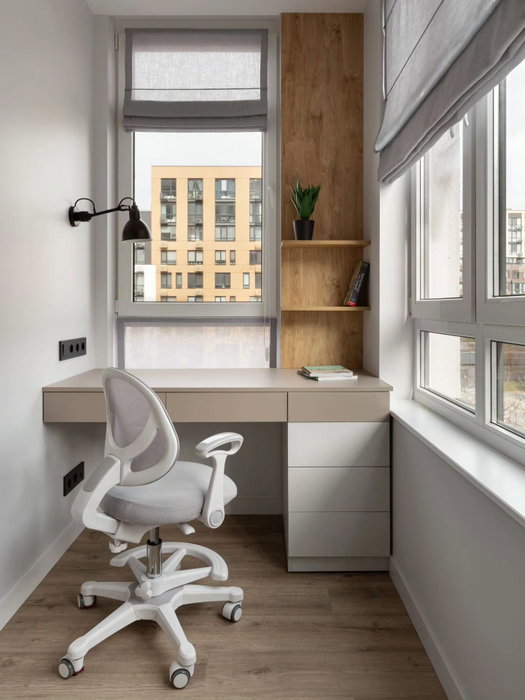
Latest work by SI, ARMARIO
@si.armario
Made-to-measure wardrobes and walk-in wardrobes
Latest posts
Cleaning and performance by finish
The finish protects the wood and determines how much care it needs. A matt water-based varnish can be cleaned with a damp cloth and hides fingerprints; a natural oil gives a warm feel but may need touching up over time; lacquer resists wear and is easy to clean, although it hides the grain.
The humidity on the Málaga coast also plays a part: solid wood expands and contracts a little more than veneer on board. In a well-ventilated walk-in wardrobe the effect is small, but it's worth knowing if the room is next to a bathroom. We specify the finish for each piece so you know how to look after it.
Ask us to come and measure up in Nerja
- 01You leave us your name and your area.
- 02We message you on WhatsApp to agree a day.
- 03The measuring visit costs €50 and is free if you place an order.
How the material affects your quote
Wood is the item that raises or lowers the cost of a walk-in wardrobe the most. Solid wood is the most expensive, natural veneer sits in the middle and decorative board is the most economical option. But the material isn't everything: the linear metres of units, the number of drawers and the hardware you choose all count too.
A smart way to adjust the cost is to keep the quality material for what's visible and use decorative board for the interiors. That way you get the look you want without paying for genuine wood where nobody sees it. Our pricing page explains the factors that move the cost of a walk-in wardrobe.
Choosing a modern or rustic style
- 01
Wood doesn't define the style on its own. A light oak with straight lines and no handles feels contemporary; the same oak with frames, mouldings and turned handles moves towards classic. If you already have a clear idea, there are dedicated pages for modern walk-in wardrobes and rustic wooden walk-in wardrobes, where the decisions for each look are covered in detail.
- 02
Here, it's enough to be clear about the material and the tone. The style is settled afterwards, with the lines, fittings and layout that best express it in your home. Choosing the material first and the look second avoids the opposite mistake, which is falling in love with a photo and then finding out its finish doesn't fit your budget.
Preparing your project in Nerja
The short route is the configurator: you enter the measurements, layout and type of material, and a design is prepared and sent to our team. Once your configuration with the measurements arrives, we reply with a guide price the following day. The measuring visit comes afterwards: it costs €50 if you don't go ahead and is not charged if you place the order. Making the unit takes, on average, two to three weeks.
If you're torn between two materials, say so in the form and we'll compare both on the same plan, with the price of each clearly shown, so you can decide on facts rather than first impressions.
Enquiry
Tell us about your project in Nerja
- 1We read your message and look at your photos.
- 2We reply on WhatsApp with a first figure.
- 3We measure up and prepare the final quote. The measuring visit costs €50 if you don't go ahead with the order and is free if you do.
We don't cut a single board until you've approved the design and the price.
Questions
Frequently asked questions about wardrobes in Nerja
After installation: warranty and care for your wardrobe.
Which parts of a walk-in wardrobe can be made from natural wood?
Drawer fronts, visible sides, upper shelves, the bench and trim. The internal structure is usually engineered board for stability. They are combined so that what's visible has genuine wood and the rest doesn't push up the cost of the project.
How do I know whether the wood in my proposal is genuine or an imitation?
Natural veneer is real laminated wood, with an irregular grain that doesn't repeat between pieces and an edge in the same material. A wood-effect finish repeats the pattern and has a synthetic edge. Both are listed by name in the proposal.
Does the whole unit have to be in the same board or veneer?
No, and it's often better if it isn't. Wood where it's seen, plain board where it isn't, and a supporting tone for contrast. What matters most is that the chosen finishes work with the light in the room.
When is the final tone of the wood for my walk-in wardrobe settled?
With physical samples held against your wall and a written reference for each finish. Once approved, the unit is made to that reference and not to a similar one.
Does wood stand up well to the coastal climate?
With a suitable finish and a ventilated room, yes. Veneer on board is more stable than solid wood when humidity changes, and a varnish or oil protects the surface. In a walk-in wardrobe next to a bathroom in Nerja, it's worth making extra sure the room is well ventilated.
Shall we talk about your project?
Send us a photo of the space and some approximate measurements on WhatsApp: we'll give you some initial guidance and arrange the measuring visit.